
Ever had a brilliant idea for a room makeover in your head but struggled to explain it or make it a reality? A mood board is the creative tool that bridges that gap. It's a visual collage of images, textures, colors, and materials that nails down the exact feeling and style you're aiming for. Think of it as your project's North Star, guiding every decision before you spend a single dollar.
Your Design Blueprint: What a Mood Board Really Is
Imagine a mood board as the visual recipe for your room. It’s much more than a collection of pretty pictures; it’s a strategic tool that defines the entire look and feel of your space. It’s what takes an abstract idea like "cozy modern" or "airy Japandi" (a blend of Japanese minimalism and Scandinavian function) and makes it tangible.
This collage becomes your reference point, ensuring that every choice—from the paint color to the cabinet hardware—lines up with your original vision. It keeps the project focused and prevents that common pitfall where a room ends up feeling like a random assortment of things you bought on a whim.
A Powerful Communication Tool
One of the biggest wins of creating a mood board is getting everyone on the same page. It's the perfect way to build a shared vision with a partner, family member, or contractor. Instead of trying to describe what you mean by "warm and inviting," you can just point to the board. Everyone sees the same thing, which avoids costly misunderstandings.
This clarity is a game-changer for so many people:
- For Homeowners: A mood board is your best defense against expensive mistakes and buyer's remorse. You get to test-drive your ideas and confirm you love the final look before you start buying furniture. This is especially helpful for families trying to balance style with durability.
- For Airbnb Hosts: It helps you craft a photogenic, five-star space with a consistent theme that grabs attention, boosts your listing's appeal, and helps you how to increase Airbnb bookings.
- For Real Estate Agents: You can use a mood board to show a compelling visual plan for staging a property, helping potential buyers immediately see a home’s hidden potential.
From Vague Idea to Actionable Plan
Ultimately, a mood board connects your inspiration to the actual work. It cuts down on decision stress by giving you a clear filter for what works and what doesn't. You can quickly explore different concepts without spending a dime. For example, using a tool like AI Interior Designer lets you instantly visualize how different mood board styles look in your actual room, helping you test ideas risk-free. See how different styles come together in our design gallery.
By putting in a little time to create a mood board upfront, you save yourself a ton of time, money, and stress later on. It’s the best way to make sure the room you end up with is the one you were dreaming of all along.
Why a Mood Board Is Your Most Important Design Tool
Every great design project, from a simple bedroom refresh to a full-scale renovation, begins with a clear, visual plan. Think of a mood board as the bridge between the fuzzy ideas in your head—like "cozy and modern"—and the actual furniture, colors, and textures you'll bring into your home.
Without one, it's easy to end up with a room that feels disjointed or looks like a random assortment of things you bought on a whim. A mood board is your first, and best, line of defense to ensure the final result is a space that feels intentional and truly yours.
Save Time and Money
Creating a mood board is one of the smartest financial moves you can make in any design project. By mapping everything out before you buy a single thing, you can avoid expensive mistakes, impulse buys that don't quite fit, and annoying returns. This is crucial whether you're working with a tight budget in a small apartment or furnishing an entire rental property.
You get to see how that pricey sofa actually pairs with your chosen rug and paint color before you've committed. This is where modern tools really shine. An AI Interior Designer can take your mood board elements and show you how they’ll look in a photo of your actual room, giving you priceless confirmation before you spend a dime.
Make Confident Decisions and Reduce Stress
Ever walked into a furniture store and felt a wave of decision paralysis? With thousands of options, it's easy to get overwhelmed. Your mood board cuts through that noise. It acts as your personal design compass, giving you a clear "yes" or "no" for every choice.
A well-defined mood board turns a sea of overwhelming choices into a curated list of possibilities. It’s not about limiting creativity; it’s about focusing it to create a space that feels intentional and complete.
When you clarify your vision from the start, you can shop with total confidence, knowing that every item you select is another perfect piece of the puzzle. This drastically reduces the stress that comes with big design decisions.
Boost Your Property’s Appeal
If you're an Airbnb host or a real estate agent, a mood board is more than just a creative exercise—it's a powerful business tool. It's the secret to designing a photogenic, five-star space that grabs attention online, boosts your listing's appeal, and stands out in a crowded market.
A cohesive, well-planned design helps you:
- Create a memorable theme: Whether it's a "Coastal Retreat" for a vacation rental or an "Urban Loft" for a city apartment, a consistent look helps potential guests and buyers form an instant emotional connection.
- Stage for maximum impact: A clear plan ensures your staging is effective, highlighting the home’s best features so it can sell faster or book more nights.
- Justify a higher price point: A space that looks professionally designed simply feels more valuable, which can support higher rental rates or a better selling price.
The Building Blocks of a Powerful Mood Board
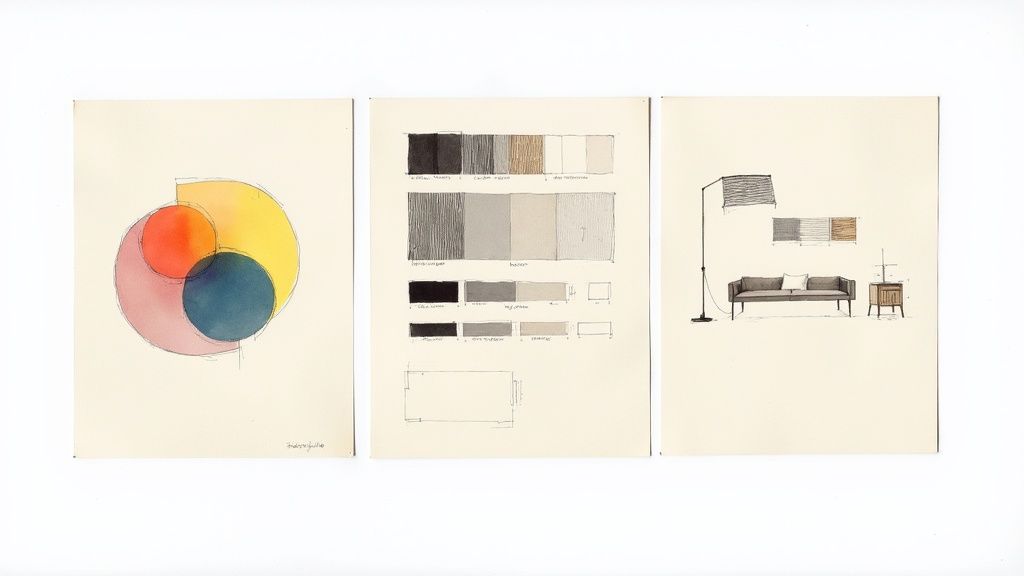
A truly effective mood board is more than a collage of pretty pictures. It’s a curated collection of specific design ingredients that work together to create a practical blueprint for your actual room.
Think of it like gathering all your ingredients before you start cooking a new recipe. Each element plays a distinct role, ensuring the final dish—your room—feels cohesive and complete. This is exactly how you turn a vague feeling into a solid plan that saves you time and money.
Define Your Color Palette
Color is the emotional backbone of any space. A well-defined palette is the first step toward nailing that cohesive look you're after. Instead of just grabbing random colors you like, structure them with a clear purpose.
- Primary Colors: These are your main players, the shades that will cover the most surface area—think walls and large furniture. For a living room, this might be a warm gray, a soft off-white, or a comforting beige.
- Secondary Colors: These act as the supporting cast, adding depth. You might see them on an accent wall, in your curtains, or across a large area rug.
- Accent Colors: These are the little pops of energy used sparingly to add personality. Think throw pillows, a piece of art, or a decorative vase in a kitchen.
Choosing the right shades can feel like a huge decision. If you need help, our guide on how to choose paint colors for rooms has practical tips to get you started.
Select Key Materials and Textures
Materials and textures are what bring a room to life. They add warmth, depth, and character, preventing a space from ever feeling flat or one-dimensional. A great mood board should always include tangible examples of these finishes.
Your mood board should be a sensory preview of your space. Including textures like rough linen, smooth marble, or warm wood helps you understand how the room will actually feel, not just how it will look.
Get specific and start gathering samples or clear images of:
- Wood Grains: Light oak for a Scandinavian feel, or rich walnut for a mid-century modern look?
- Metal Finishes: Brushed brass, matte black, or polished chrome will dramatically change the feel of your bathroom or kitchen fixtures.
- Fabrics: Collect swatches of linen, velvet, or leather to see how they feel for sofas, chairs, and pillows, especially in high-traffic family rooms.
- Hard Surfaces: Find samples of your ideal countertops, floor tiles, or a backsplash pattern.
Choose Your Furniture and Decor Silhouettes
The shape and form of your furniture—its silhouette—is what really defines a room's character. Are you drawn to soft, curved shapes, or do you prefer clean, straight lines? Add images of key pieces to your board.
This is where you balance dreams with real-world constraints like budget and space. It's smart to include both aspirational pieces that capture the style you love and specific, shoppable items that actually fit your room's scale.
It can be tough to visualize how a giant curved sofa will actually look in your small apartment. This is where an AI Interior Designer is a huge help. You can test different furniture silhouettes right in a photo of your room to see what works with your layout before you commit to a purchase.
Physical vs. Digital Mood Boards: Which Is Right for You?
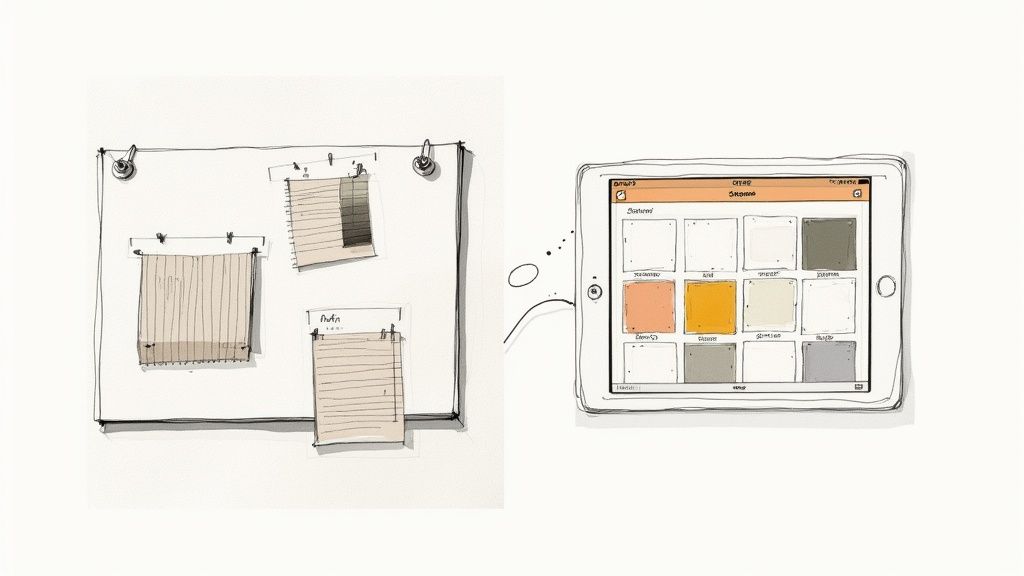
When you're ready to start mood boarding, you'll find yourself at a crossroads: do you go old-school with a physical board or embrace the flexibility of a digital one? Honestly, there’s no wrong answer. The best choice comes down to your personal workflow and what feels most creative to you.
The Case for Physical Mood Boards
There’s something incredibly satisfying about a physical mood board. This is the classic corkboard-and-pins approach, where you get to play with real, tangible materials like fabric swatches, paint chips, and scraps of wallpaper.
The magic here is the sensory experience. You can see how that velvet swatch catches the light or feel the texture of a rug sample next to a cool metal finish. It’s a hands-on process that gives you a true-to-life preview of how materials will coexist in your space, grounded in reality.
The Power of Digital Mood Boards
On the other side, digital mood boards offer a world of convenience and speed. Using tools like Pinterest or Canva, you can pull together a massive collection of ideas in minutes. Found a sofa you love online? Just drag and drop the image. Want to see how a different color looks? A few clicks and it’s done.
This method is perfect for rapid brainstorming and collaboration. You can easily share your board with a designer, contractor, or partner for instant feedback. Plus, making changes is completely mess-free—no glue or pinholes involved.
Physical Mood Board vs. Digital Mood Board
Here's a simple breakdown to help you decide.
| Feature | Physical Mood Board | Digital Mood Board |
|---|---|---|
| Tactility | High. Allows you to touch and feel real materials. | Low. Visuals only; no physical texture. |
| Flexibility | Low. Changes can be time-consuming and messy. | High. Easy to add, remove, and rearrange elements. |
| Sharing | Difficult. Requires in-person viewing or photos. | Effortless. Shareable via a simple link or file. |
| Cost | Can have costs for materials (board, printing, samples). | Often free or low-cost, using readily available images. |
| Accessibility | Limited to a physical location. | Accessible from any device, anywhere. |
| Realism | Excellent. Shows true colors and textures in real light. | Good. Relies on screen calibration and image quality. |
Ultimately, you don't have to choose just one. Many people start digitally to gather broad ideas and then create a smaller, physical board with their final selections.
The Evolution of Mood Boarding
While designers have used mood boards since the 1980s, the digital boom of the 1990s changed the game. Suddenly, this professional technique was no longer just for the pros. For more on this history, Next.cc has a great overview.
This shift put incredible design tools into the hands of homeowners and renters, allowing anyone to visualize their space. Today, we get the best of both worlds. For anyone new to this, checking out some of the best interior design software for beginners can be a fantastic starting point.
A physical board helps you feel the textures, while a digital board helps you test the possibilities. The best approach often involves using both to create a design that looks good on screen and feels right in your home.
Bridging the Gap with AI
So, how do you get the real-world confidence of a physical board with the endless possibilities of a digital one? This is where modern AI tools are making a huge difference. An AI Interior Designer acts as the perfect bridge between your digital vision and your actual room.
You can build a digital mood board and then use AI to instantly see how those concepts look in a photo of your own living room or bedroom. This helps you test that bold color palette or specific furniture style against your home’s unique lighting and architecture. It takes the guesswork out of the equation, saving you from expensive mistakes and ensuring the final result is exactly what you hoped for.
How to Create Your First Interior Design Mood Board
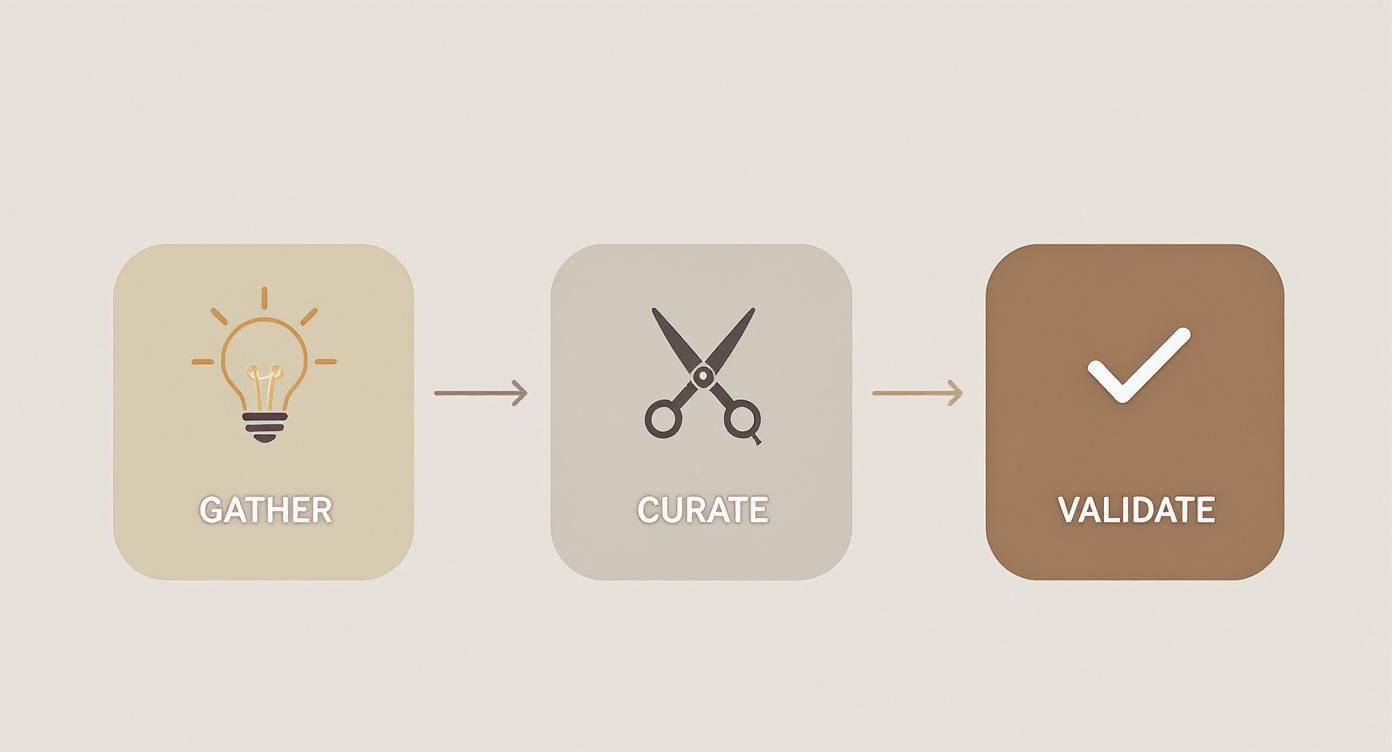
Ready to bring that vision in your head to life? Let's walk through building your first mood board. Think of it less as a chore and more as a creative playground that will ultimately save you time, money, and headaches. Here are four simple, practical steps.
Step 1: Define Your Vision
Before pinning a single image, pause and ask yourself a crucial question: how do I want this room to feel?
Forget specific styles for a minute. Instead, focus on the emotional vibe. Do you want your bedroom to feel calm and serene, your living room buzzing with energy, your kitchen cozy like a warm hug, or your bathroom sleek and sophisticated? Jot down 3-5 of these "feeling" words. They'll become your guide.
Step 2: Gather Your Inspiration
Now for the fun part—the treasure hunt. Cast a wide net and start collecting anything that catches your eye. Don't overthink it at this stage; just gather.
- Online Goldmines: Pinterest and Instagram are obvious starting points.
- Good Old-Fashioned Print: Flip through a design magazine or book. Tearing out a page you love creates a tangible connection to your ideas.
- The World Around You: Inspiration isn't confined to a screen. Snap a picture of a friend's living room that just feels right, the texture of a stone wall on your favorite building, or the color palette of a beautiful outdoor space.
Step 3: Curate and Refine
This is where the magic really happens. You've got a mountain of inspiration, and now it's time to become the editor of your own design story.
Go back to those core feeling words from Step 1. Look at every single image and ask, "Does this fit my vision? Does it evoke 'calm' or 'energetic'?" If the answer is no, be ruthless and get rid of it. Your goal is to shrink that big pile into a focused, curated collection of elements that sing in harmony. You'll start to see a clear direction emerge.
Step 4: Assemble and Validate Your Concept
Now, arrange your final selections—your images, fabric swatches, and paint chips—onto a physical board or a digital canvas. But don't stop there. The final, game-changing step is to see how it all works in your actual room.
This is where a tool like an AI Interior Designer is a lifesaver. Instead of just hoping it will all come together, you can take a photo of your room and instantly see your mood board's style applied to your space. You get to preview how that new color scheme or furniture layout looks with your home’s unique lighting and architecture.
Validating your mood board with an AI render takes the guesswork—and the biggest risk—out of any design project. You can experiment with different looks with zero cost or commitment, making sure you’ll love the final result before you even start.
While AI is a powerful visualization tool, remember its limitations. It's fantastic for generating ideas, but always combine its suggestions with your personal taste. For complex projects, consulting a professional interior designer is still a great idea.
Common Questions About Mood Boards
As you dive into the design process, a few practical questions are bound to pop up. Let's tackle some of the most common ones to help you build your mood board with confidence.
How many images should I put on a mood board?
This is a classic case of quality over quantity. A powerful mood board tells a single, focused story. Aim for 10-15 core images that truly nail the feeling you're after.
If you have too few, the idea might feel incomplete. But cram in too many, and you'll end up with a cluttered mess. A good trick is to gather a big batch of images first—maybe 30 or 40 things you love—and then edit ruthlessly, keeping only the elements that work together beautifully.
What is the difference between a mood board and a Pinterest board?
Think of your Pinterest board as the wide-open brainstorming session. It’s your digital scrapbook for anything that catches your eye, no filter necessary. A mood board is what comes next: it's the edited, curated blueprint you create from all that raw inspiration.
After you've pinned to your heart's content, you'll sift through it all and pull out the most cohesive pieces—the specific colors, furniture styles, and textures—to assemble your final mood board. The Pinterest board is the library of possibilities; the mood board is the final, focused design direction.
Can I use a mood board for a small apartment?
Absolutely! In fact, a mood board is essential for a small space, including rented apartments where you can't make permanent changes. When every square inch counts, every single design choice has a huge impact.
A mood board is your secret weapon for making a small room feel intentional and cohesive, not cramped or chaotic. You can use it to:
- Test out color palettes that create an illusion of space.
- Find multi-functional furniture that works smarter, not harder.
- Plan decor that adds personality without adding clutter, like peel-and-stick wallpaper or statement art.
How can a mood board help if my partner and I disagree on style?
Ah, the classic design dilemma. A mood board can be a fantastic mediator. Instead of arguing about vague words like "modern" or "cozy," you can both find images that show what those words mean to you.
When you put your visuals together on a shared board, you'll start to see where your tastes overlap. Maybe you both love the same deep green accent color, or you're both drawn to simple furniture lines. It turns a potential argument into a creative, collaborative project, helping you find a middle ground you both genuinely love. For more answers, feel free to explore our complete FAQ section.
Ready to stop guessing and start visualizing? Try Interior Redesigne AI to instantly reimagine your room from a photo or sketch and bring your mood board to life.