
Kicking off a renovation without a solid budget is a classic recipe for disaster. It’s like setting out on a long hike without a map—you’ll eventually get somewhere, but you’ll probably be stressed, lost, and way over budget by the time you do. A detailed cost estimate is the single most important tool in your project toolkit, guiding every decision you make from start to finish.
Why You Can't Afford to Skip the Renovation Estimate
Let’s be honest, pinning down renovation costs can feel like a huge headache. But it's the one step that truly separates a smooth, successful project from a chaotic, money-draining nightmare. A well-researched budget is your first line of defense against dreaded surprise expenses. It keeps everything on track and saves you from the anxiety of watching costs spiral out of control.
For anyone in real estate, from agents to Airbnb hosts, a sharp estimate isn't just about planning—it's about making a smart investment that boosts property value and guest appeal.
This early planning stage is where you translate your big ideas into an actionable plan. Before you can even think about numbers, you need to be crystal clear on what you actually want. Visualizing your ideas first is a complete game-changer. For example, using an AI Interior Designer like Interior Redesigne AI, you can snap a photo of your living room and instantly see what it would look like with different paint colors, a new furniture layout, or a completely different style like Japandi (that beautiful blend of Japanese minimalism and Scandinavian warmth).
When you can see the possibilities laid out in front of you, it’s much easier to nail down your "must-haves" versus your "nice-to-haves." That clarity is the bedrock of any realistic budget. This flowchart breaks down how you move from a creative spark to a solid financial plan.
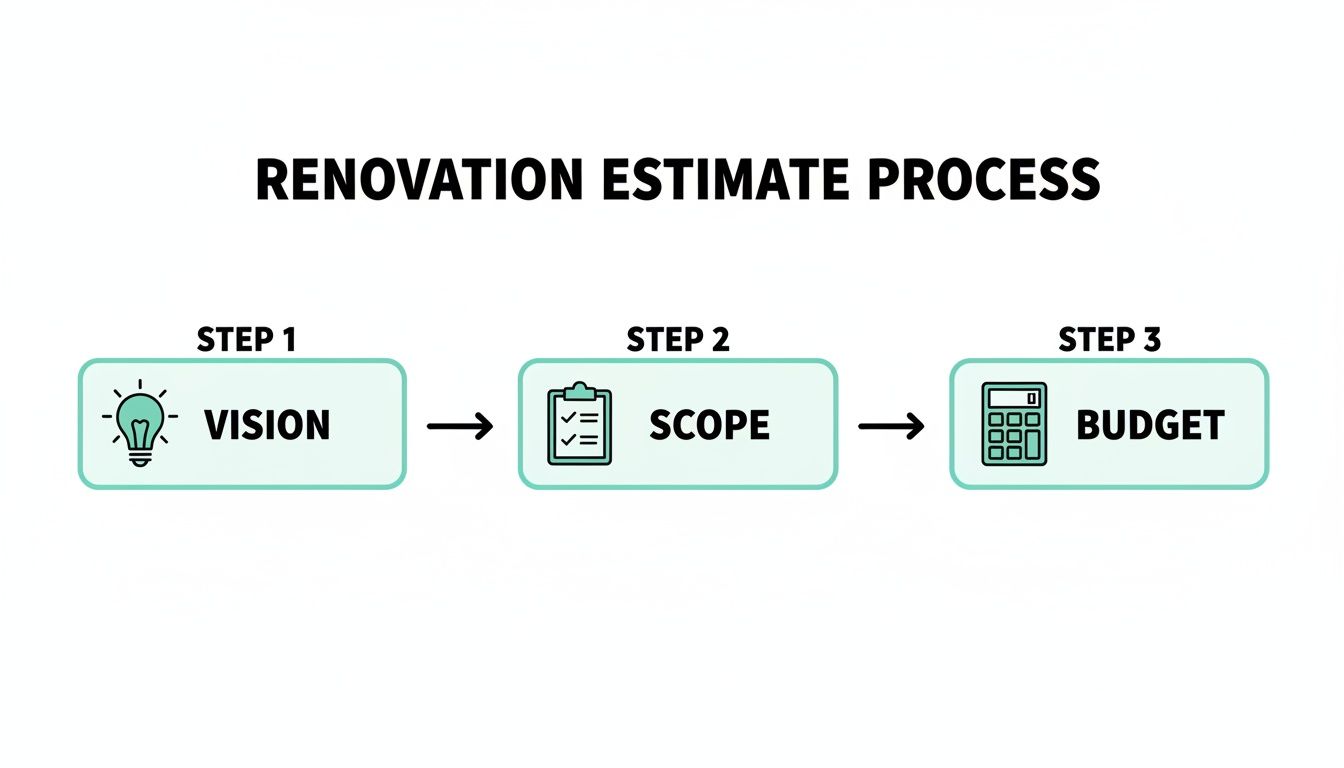
As you can see, a workable budget isn't pulled out of thin air. It’s built on a clearly defined vision and a detailed scope of work.
The Financial Reality of Remodeling
It’s no secret that home remodeling is a massive industry, projected to hit an incredible $1.29 trillion by 2030. But with that growth comes challenges, like unpredictable material costs and supply chain issues, which make accurate budgeting more crucial than ever.
A good estimate does more than just keep your spending in check; it puts you in the driver's seat. It helps you:
- Prevent Financial Strain: Nothing kills a project faster than running out of money halfway through. A budget prevents this common pitfall.
- Stay on Schedule: When contractors know the budget, they can line up materials and labor much more efficiently, keeping things moving.
- Make Confident Decisions: Knowing your numbers makes it easier to decide between different finishes, appliances, or contractors without second-guessing yourself.
- Secure Financing: If you're applying for a renovation loan, lenders will absolutely require a detailed cost breakdown.
Ultimately, a detailed estimate gives you control and peace of mind. For a deeper look at orchestrating a major project, check out our guide on planning a whole home renovation.
Defining Your Project Scope for a Clearer Budget
A fuzzy plan is the fastest way to an inflated budget. Before you can even begin to estimate renovation costs, you have to nail down exactly what you want to achieve. This is what we call defining your project scope, and it's your roadmap to keeping costs under control.
Think of it as your ultimate wish list, but with all the nitty-gritty details. Are we just talking a fresh coat of paint in the living room? Or are we also tearing out the old carpet, installing new light fixtures, and adding built-in shelves? Every decision is a new line item in your budget.
This is the stage where dreams can easily run away from reality. It's so easy to get lost in stunning Pinterest boards without thinking through the practical side of things, especially if you're working with the real-world constraints of an apartment or a rental property.

From Wish List to Action Plan
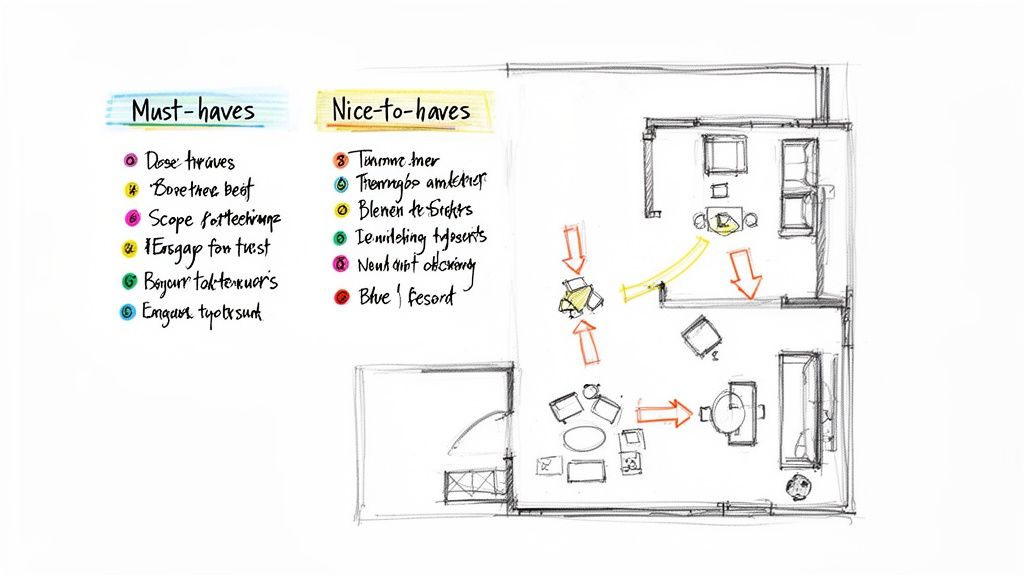
Alright, you have your dream list. Now it's time to get a little ruthless. Sort every item into must-haves and nice-to-haves. This is your best defense against "scope creep"—that sneaky process where small additions slowly blow up your budget.
Must-Haves: These are your non-negotiables. It could be a functional fix, like a leaky bathroom faucet, or a practical need, like replacing worn-out kitchen counters. For an Airbnb host, a durable new sofa that can handle constant use is definitely a "must-have."
Nice-to-Haves: This is the fun stuff you'd love but could live without if the budget gets tight. Think heated floors in the bathroom, a fancy European appliance package, or custom-milled cabinetry.
Visualize to Finalize Your Renovation Scope
At this point, planning can feel a bit abstract. How do you really know if taking down that wall will make the living room feel better? Guessing is an expensive game.
This is where a tool like Interior Redesigne AI can be a game-changer. Instead of just imagining it, you can actually see it.
Pop a photo of your current kitchen into the tool and, in seconds, you can see hyper-realistic images of it with different cabinet colors, countertop materials, or a totally new layout. This helps you lock in decisions with confidence. When you can see that a great quartz countertop gives you 90% of the visual impact of marble for a fraction of the price, the choice becomes a no-brainer. Visualizing the end result makes your final cost estimate much, much more reliable.
Don't Forget the Details
A solid scope goes way beyond just the pretty finishes. You need to think through every layer of the job. For any room, make sure you're thinking about these less-glamorous, but absolutely essential, details:
- Structural Changes: Are you moving walls, adding windows, or changing a doorway?
- Systems Updates: Do you need to reroute plumbing for a new sink or upgrade electrical for modern lighting?
- Finishing Touches: This covers everything from paint colors and trim styles to cabinet pulls and outlet covers.
- Outdoor Spaces: An outdoor makeover involves a whole different set of considerations. Getting a handle on specifics, like how to design a front yard landscape, helps you define the scope and budget for those exterior projects far more accurately.
Tallying Up the Real Costs: Materials, Labor, and What’s Hiding in the Walls
Alright, you’ve got a solid plan. Now for the hard part: putting real numbers to that vision. This is where we break down the two biggest players in any renovation budget—materials and labor—and, just as importantly, talk about the sneaky "hidden" costs that trip up so many homeowners.
Recent surveys show that 63% of homeowners are most concerned about the rising cost of products and materials. This is followed closely by worries over higher labor costs (31%) and finding good, available pros (25%). This is exactly why getting a handle on these expenses from the get-go is more critical than ever.
Breaking Down Material Costs
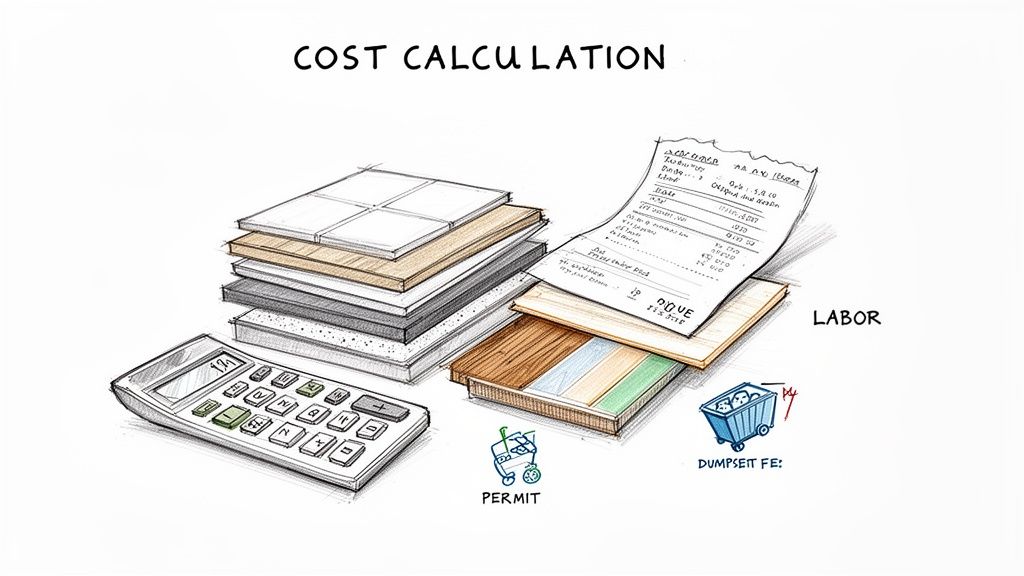
Materials are all the physical things you'll be buying and installing. You'll generally use one of two methods to estimate their cost:
By Square Footage (PSF): This is for anything that covers a surface, like flooring, paint, or tile. Simply calculate the area of the space and multiply it by the material's price per square foot. Example: Flooring a 150 sq. ft. bedroom with vinyl plank that costs $6/sq. ft. is 150 x $6 = $900.
By Unit: This is for all the one-off items. Think of a new bathroom vanity, a light fixture, or a set of kitchen appliances. For these, just make a list and add up their individual prices.
Digital planning can save you a ton of money here. Seeing your design choices virtually with a tool like Interior Flux Studio AI lets you compare that high-end marble backsplash with a more budget-friendly ceramic tile before you ever spend a dime.
Getting a Handle on Labor Rates
Labor is often the biggest wild card, typically eating up 25% to 40% of the total project cost. What you'll pay depends on your local market, job complexity, and the specific trade skills needed.
To get a realistic number:
- Research Local Averages: Do a quick search for the going hourly rates for carpenters, electricians, and painters in your city.
- Ask Around: Your best intel often comes from friends, neighbors, or local online groups.
- Get Multiple Bids: This is non-negotiable. Get at least three detailed quotes from qualified professionals. It's the most accurate way to pin down labor costs for your exact project.
For those managing multiple trades, a tool like the Exayard construction estimating platform can help you quantify every detail. And if you're taking on the project manager role yourself, check out our guide to the best home renovation apps to keep everything on track.
Uncovering the Hidden Costs
The items that truly blow up a budget are the ones most people never see coming. You need to give these their own line items in your spreadsheet.
Here’s a quick checklist of common surprise expenses you absolutely need to account for:
- Permit Fees: Building, electrical, or plumbing permits can run from a couple of hundred to several thousand dollars.
- Designer or Architect Fees: For complex layouts or structural changes, you'll need professional plans.
- Debris Removal: Renting a dumpster or hiring a junk removal service isn't free.
- Temporary Living Expenses: If your kitchen or only bathroom is out of commission, you need to budget for more takeout or even a short-term rental.
- Unexpected Repairs: This is the big one. You truly never know what you'll find when you open up a wall—from outdated wiring and leaky pipes to termite damage.
Preparing for the Unexpected: Contingency Funds and Smart Quotes
If there's one thing I can tell you with absolute certainty, it's this: every single renovation has a surprise. It's not a matter of if, but when. That’s precisely why a contingency fund isn't just a good idea—it's the most critical line item in your budget.
The rule of thumb is to set aside 10% to 20% of your total estimated project cost. For a simple cosmetic refresh, 10% might be enough. But if you’re renovating an older house or moving walls, you'll sleep much better with 20% tucked away. This fund is what saves the day when you find that ancient wiring in the walls or discover the tile you love is backordered for months.
How to Get and Compare Contractor Quotes
Getting quotes is about more than just finding the lowest price. Be wary of a bid that's dramatically lower than the others; it's often a red flag. What you want is a line-item bid, a detailed breakdown that tells you exactly where your money is going.
Insist that any quote includes:
- Materials: Specifics on brands, models, and quantities.
- Labor: A breakdown of costs for each trade.
- Permits and Fees: A clear list of all administrative expenses.
- Project Timeline: A realistic start and estimated completion date.
A quote that just says "Kitchen Remodel: $45,000" isn't good enough. To get precise quotes, show contractors exactly what you want. Using a tool like Interior Redesigne AI to create photorealistic renderings of your design eliminates guesswork and ensures everyone is bidding on the exact same project.
When comparing bids, always:
- Check Licenses and Insurance: Ask for proof of liability and worker's comp insurance.
- Talk to References: Call at least two recent clients. Ask if they stuck to the budget and finished on time.
- Review Their Portfolio: Look at photos of their work to ensure the quality meets your standards.
Choosing the right contractor is half the battle. If you're looking for more ways to visualize your project, you might want to check out some different types of home renovation design software.
How to Reduce Costs Without Sacrificing Quality
A beautiful renovation doesn't have to break the bank. The secret to a budget-friendly project is making smart, strategic decisions that give you the most impact for your money. This is how savvy homeowners create a space they adore, real estate agents maximize a property's sale price, and Airbnb hosts design a rental that looks far more luxurious than its budget.
The Smart Way to DIY
Doing some work yourself is a quick way to shrink your budget, since labor can be up to 40% of the total cost. But be brutally honest about your skill level. Your best bet is to focus on tasks that are high-impact but low-risk.
- Demolition: Tearing out old cabinets or ripping up carpet can save you hundreds, even thousands, in labor fees.
- Painting: Nothing transforms a space faster than a fresh coat of paint. It's time-consuming but a straightforward job for most people.
- Minor Landscaping: Clearing brush, planting flowers, or spreading mulch are perfect weekend projects that make a huge difference.
A Word of Caution: Always leave electrical, plumbing, and structural work to licensed professionals. The risk of fire, water damage, or structural failure is too high. This is one area where trying to save money now can cost you a fortune later.
Make Savvy Material Swaps
High-end materials look fantastic, but we're living in a golden age of alternatives that deliver a premium look for a fraction of the cost. Many of these wallet-friendly options are actually more durable and easier to maintain—a massive win for busy families or high-traffic rental properties.
Before you commit, visualize different options in your actual room. A tool like the Interior Flux Studio AI can instantly show you the difference between a real marble countertop and a high-quality quartz alternative. Seeing them side-by-side often reveals that a less expensive option gives you the exact look you wanted.
High-Impact vs. Low-Cost Renovation Ideas
| Project Area | High-Cost Splurge (When It's Worth It) | Smart-Save Alternative |
|---|---|---|
| Kitchen Cabinets | Full Custom Cabinetry | Refinish or reface existing cabinets. A pro paint job or new doors can make them look brand new for 50-70% less. |
| Flooring | Solid Hardwood Flooring | Luxury Vinyl Plank (LVP). Modern LVP has incredibly realistic wood looks, is waterproof, and is easier to install. |
| Tile (Backsplash/Bath) | Natural Stone (Marble, Slate) | High-quality porcelain or ceramic. Today's porcelain can mimic natural stone with stunning accuracy while being far more durable. |
| Countertops | Exotic Granite or Marble | Quartz or Butcher Block. Quartz is non-porous and ultra-durable, while butcher block adds warmth and can be refinished over time. |
Time Your Project Strategically
Here’s an insider tip: timing is everything. Contractors have busy and slow seasons. Demand skyrockets in spring and summer. If you have flexibility, try scheduling your project during a contractor's off-season, usually late fall or winter. During these slower months, contractors are more likely to negotiate on price to keep their crews working. You might find bids come in 5% to 15% lower than they would during peak season.
Putting Your Renovation Budget Template to Work
Seeing the numbers laid out for a real-world project makes everything click. Let's walk through a common scenario: a mid-grade renovation of a small bathroom. This example shows how to organize your plan and get a solid handle on your estimate renovation costs.
Let's picture a typical 5' x 8' (40 square foot) bathroom. The plan is a practical but stylish update—new fixtures and tile—without the massive expense of moving any plumbing.
Sample Budget Breakdown: 5' x 8' Bathroom
Here’s how a line-item budget for this kind of project might shape up.
- Vanity & Sink: $600
- Faucet & Fixtures: $300
- Toilet: $350
- Tub & Shower System: $900
- Floor & Wall Tile: $1,200
- Lighting & Mirror: $400
- Paint & Supplies: $150
Subtotal Materials: $3,900
Now, let's factor in the other critical costs:
- Labor Costs: Expect to pay around $5,500 for demolition, plumbing, tiling, installation, and painting.
- Permit Fees: $300 is a reasonable placeholder.
- Debris Removal: Budget $250 for a small dumpster or junk hauling service.
This brings our estimated project cost to $9,950.
The Final, Crucial Step: Never forget the contingency fund. A 15% buffer is smart, adding $1,492.50 for the inevitable "oops" moments. This brings our all-in grand total to a much more realistic $11,442.50.
When you use a structured approach like this, a complex project suddenly feels manageable. For a more granular breakdown, our complete bathroom renovation planner can guide you through every decision.
Common Renovation Budgeting Questions
When you're staring down the barrel of a renovation, the financial side of things can feel overwhelming. Let's tackle some of the most frequent questions homeowners ask.
How Much Should a Renovation Cost Per Square Foot?
The honest answer is, "it depends." A full-gut renovation could run anywhere from $150 to over $350 per square foot, heavily influenced by where you live and the quality of your finishes.
To get more specific, a mid-range kitchen remodel often comes in around $335 per square foot. Bathrooms can easily hit $600 per square foot because you're packing complex plumbing, tile, and electrical work into a tiny footprint. Use these numbers as a starting point for your research, not a fixed price.
Is It Cheaper to Renovate or Build New?
For the most part, renovating your existing home will be easier on your wallet than building a brand new one. You're saving a huge amount by working with the existing foundation, framing, and major systems.
That said, there's a tipping point. If you're planning a massive, down-to-the-studs renovation on an older home, the costs can start to creep up toward new construction prices, especially if you uncover major issues. But for typical updates, sticking with your current structure is usually the more economical choice.
How Can AI Help With My Budget?
While AI can't give you a contractor's quote, it's a fantastic tool for what I call cost avoidance.
Imagine you’re deciding between real hardwood and a high-end luxury vinyl tile. Instead of guessing, you can use an AI interior design tool to instantly visualize both options in your actual room. Seeing that the less expensive material achieves the exact look you're after gives you the confidence to lock in that decision, saving you from a costly mistake.
Experimenting with dozens of design ideas virtually costs nothing. Changing your mind after your contractor has already bought and installed materials can cost thousands. AI is a powerful tool, but it's most effective when you combine its ideas with your own taste. Be honest about its limitations and consider consulting a professional designer for complex projects.
Ready to visualize your ideas and lock in your project scope with confidence? Try Interior Redesigne AI to instantly reimagine your room from a photo or sketch, helping you make smart design choices that fit your budget. Start your redesign now!